
Driving Into the Storm, Canada’s Auto Industry Under Tariffs
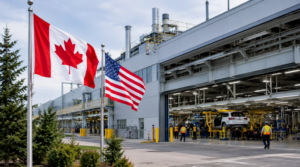
For more than fifty years Canada’s auto industry was built on a simple premise, integrated North American plants assembled with vehicles flowing freely across borders. With the United States as both supplier and customer, that deal is now under strain from all sides at once. Tariffs, plant closures, and shifting market share have taken a toll on the industry. Add to that a federal government that’s openly courting new partners in Asia and Europe, it would seem the industry is on life support.
The tariff shock
When the United States imposed auto tariffs in April 2025, (25% levy on Canadian-built cars) with the duties expected to extend further to Canadian auto parts, and steel. Economists warned the trade restrictions could hurt U.S. production as much as protect it, since many “American made” vehicles are actually assembled in Canada or Mexico. Those warnings are proving to be true on both sides of the border.
Canadian production fell 15% year over year through April, according to figures cited by the Center for Automotive Research. Statistics Canada data show that in the wider economy, manufacturing declines played a leading role. Manufacturing grew just 1.7% in 2025, down from 2.0% in each of the previous two years, with real GDP actually contracting 0.2% in the fourth quarter.
The tariff schedule is still tightening: the levy on Canadian cars, parts and steel are expected to double on January 1, 2027.
Plants and people
The human toll is mostly concentrated in southern Ontario’s auto belt. General Motors shut the assembly line at its CAMI plant in Ingersoll, Ont. ending production of Chevrolet BrightDrop electric delivery vans. Essentially closing the plant, and impacting roughly 1,150 to 1,200 workers.
Workers, are now coming to terms with the idea that their job might never come back. U.S. automakers now assemble only about a quarter of the cars built in Canada, and their influence with the Carney government is waning as Ottawa looks overseas.
In the United States, the disruption is measured in job losses of its own. Roughly 75,000 fewer U.S. manufacturing jobs since January 2025, including 25,900 in motor vehicles and parts production. Further evidence, critics say, that the tariffs are “damaging the U.S. auto industry” as much as Canada’s.
The market is rerouting
Trade patterns are shifting faster than plants can. Vehicles built in the United States accounted for just 28.4% of Canadian new vehicle sales in the first half of 2026, down from 35.4% a year earlier. A 20% one year drop in the American share, according to J.D. Power data cited in October 2026. Mexico’s share climbed to 22.2%, while Japanese and South Korean builders gained ground as automakers rerouted supply to dodge tariff costs.
Non North American vehicles claimed 34% of Canadian monthly sales in August, up from 28.8% in March. The month before U.S. tariffs on foreign vehicles took effect, while the combined North American share fell from 71.1% to 65.9%, according to Statistics Canada data.
Forecasters see no quick recovery. TD Economics projected Canadian car sales would fall as much as 4.6% to about 1.9 million vehicles. Citing “elevated trade uncertainty” heading into the first review of the Canada–U.S–Mexico Agreement (CUSMA). “Losing CUSMA would have significant consequences for Canada and the North American auto industry,” TD warned, even extended negotiations could reshape trade relations.
Ottawa’s countermove
Prime Minister Mark Carney’s government launched a national automotive strategy in early 2026, aimed at modernizing the sector for electrification and reducing dependence on the U.S. market. That matters because, as the Prime Minister’s Office noted, more than 90% of Canadian made vehicles are exported. The plan includes $3.1 billion to help the industry diversify to new markets, and bolster manufacturing. Including battery production and the parts supply chain, plus $2.3 billion in consumer incentives, up to $5,000 to lower the price of electric vehicles.
Carney has also signalled Ottawa is prepared to walk away from Washington entirely. In mid November, he said Canada will prioritize U.S. trade talks but could pursue deals with European, Japanese or even Chinese automakers if those talks fail to protect the industry. A striking statement for a sector long dominated by the Detroit Three. Bloomberg framed the strategy bluntly, “Canada Embraces Asia to Save Auto Heartland Squeezed by US Tariffs.”
The reckoning ahead
Canada’s auto sector weathered 2025 “relatively well,” as analysts put it, but the headwinds are compounding. A doubling tariff deadline in January 2027, a CUSMA review with real dissolution risk, plant layoffs in Ingersoll, and a market share map being redrawn beneath everyone’s feet. The industry that once assumed its place in the North American bargain is now bargaining for a new one.

 -
 -
 -
 -
 -