
At ‘Lightning Speed’: Carney Chases Trade Deals Beyond America’s Shadow
From Manila to Shenzhen to Washington, Canada’s prime minister is racing to diversify Canada’s trade, with mixed results so far
Nov. 20, 2026. Standing before ASEAN leaders in Manila, Prime Minister Mark Carney announced the conclusion of negotiations for two new free trade agreements. The first one with the Association of Southeast Asian Nations and another one with the Philippines. A milestone one Toronto trade lawyer described as coming at “lightning speed.”
“Canada has successfully concluded several free trade agreements with our Association of Southeast Asian Nations counterparts and with the Philippines at kind of a lightning speed,” Margaret Kim, international trade counsel at law firm Gowling WLG, said in a interview. “These are all part of Canada’s efforts to diversify trade away from the United States given the increasing complexity of our trade relations.”
The Nov. 14 announcement, made during Carney’s visit to Manila as Guest of the Chair at the 49th ASEAN Summit, unlocks access to a market of more than 700 million people, according to the Prime Minister’s Office. The Canada – Philippines agreement came together just one year after the two countries announced their intention to pursue it, with signature targeted for 2027. As a group, ASEAN was Canada’s fifth-largest merchandise trading partner in 2025, with two-way trade valued at $52.5 billion, up 22.7% from the year before.
Still, analysts caution that there is still a lot of work to be done. An analysis by the Asia Pacific Foundation of Canada noted that Canada’s trade coverage in the region lags its peers, with a 62% share for the U.K., 63% for Australia, 67% for the European Union, and 48% for Japan. The test will be converting agreements into exports, only time will tell.
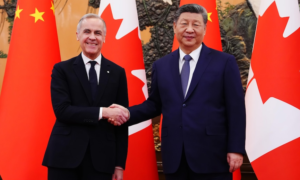
Prime Minister Carney’s most surprising opening, however, may be in China. On his first day in Shenzhen for the Asia-Pacific Economic Cooperation summit, Carney met with Chinese President Xi Jinping, and the two governments announced a series of new trade and cultural measures.
The arrangement extends and expands a January agreement in which Ottawa and Beijing exchanged market access. Canada granted relief to certain Chinese steel and aluminum products, while China suspended tariffs on some Canadian agricultural and seafood exports. That initial deal was set to expire at the end of this year, it has now been extended until Dec. 31, 2028.
The expansion extends remission coverage to 32 additional Chinese steel and aluminum items (23 steel, nine aluminum) for which Canadian supply is insufficient or unavailable. In exchange China will suspend its 25% tariff on most frozen pork cuts, a category worth $116 million in Canadian exports to China in 2024, according to a Yahoo Finance Canada analysis. Also selected seafood including frozen cold-water shrimp, through the end of 2028. Greenland halibut, some mollusks and, sea cucumber were also added. The two countries agreed to open Chinese market access for Canadian fava beans, chickpeas and lentils, and to work toward agreements on pet food and wild aquatic products by year’s end.
“This arrangement will further improve Canadian access to the Chinese market, particularly for Canada’s farmers and seafood harvesters, and provide additional relief for approximately $400 million in Canadian exports,” the Canadian government said in a statement quoted by CBC.
There are limits, however. China’s 100% tariff on Canadian canola oil remains in place, and canola seed still faces a combined duty of 14.9%, as reported by Yahoo Finance. An indication that the reset is selective and not an overall change.
The early results are measurable, since the January meeting, Canada’s exports to China have surged 40%, according to CBC, driven largely by oil, canola and peas. News analysis this week, described the trade-based reset as a deliberate pivot away from over reliance on the United States, which has imposed sweeping tariffs on Canadian goods.
The deal that is still to come
Yet none of it substitutes for the relationship that matters most. Roughly three quarters of Canadian exports flow south, and the negotiations with Washington remain the defining test of Carney’s tenure.
Those talks have lurched between hope and rupture. They collapsed in August when Canada walked away over demands Carney said threatened Canadian sovereignty and its auto industry, prompting Washington to slap 50% tariffs on roughly $20 billion in Canadian goods, with Canadian retaliation following. Trump threatened even harsher duties on autos, parts and steel effective Jan. 1.
This week, the news is that Canada is now pursuing an interim tariff arrangement with the Trump administration hopefully completed by the end of the year. The deal is said to cover Section 232 the tariffs on steel, aluminum, autos and lumber instead of a comprehensive deal. Carney described his conversation with Trump on the sidelines of APEC in Shenzhen as covering “the work underway to reach a mutually beneficial trade agreement,” and said Sunday that teams would work “in the coming weeks” toward an agreement.
The balancing act, accrual accounting.
Carney’s bet is that a diversified portfolio strengthens Canada’s hand. That deals in Manila and Shenzhen give Ottawa leverage, or at least resilience, in Washington. Analysts see genuine progress; skeptics note that new agreements take years to convert into exports, while tariffs take effect in weeks.

 -
 -
 -
 -
 -